Why asking “how do you know?” helps children learn
8 October 2026 · 5 min read

A right answer can come from understanding, from a good guess, or from remembering one just like it. From the outside they look the same. Asking a child to explain how they got there is the simplest way to tell them apart, and research suggests the explaining helps too.
What is self-explanation?
Psychologists call it self-explanation: putting into your own words why a step works or why an answer is right. It is different from being told the explanation. The learner makes it.
What does the research say?
- In a 1994 study, eighth graders read a text about the human circulatory system. Students who were prompted to explain each line to themselves came away with a better understanding than students who read it without prompts. (Chi and colleagues)
- A 2006 study with children in grades 3 to 5, working on maths equivalence problems, found that prompting them to explain answers helped them carry what they learned over to new kinds of problems. (Rittle-Johnson)
- A 2018 review that combined dozens of studies found that prompting learners to self-explain had a moderate positive effect on learning on average. (Bisra and colleagues)
It isn’t magic. A 2013 review of ten study techniques rated self-explanation as of “moderate” usefulness, partly because it takes time and works better for some material than others. (Dunlosky and colleagues) But for reasoning, where the point is the why, it fits naturally.
Five ways to ask “why?” without it feeling like a quiz
- “How did you know?” Ask it after right answers too, not only wrong ones, so it never sounds like a trap.
- “Teach me.” Children love being the expert. Play the confused grown-up and let them explain.
- “Could another answer work?” Defending one answer against another is reasoning out loud.
- “Why would someone pick that one?” Explaining a wrong option is often easier, and just as useful, as explaining the right one.
- Go first. Think out loud on your own puzzle or crossword clue. It shows that explaining is normal, not a test.
How Cub Climb uses it
Every reasoning puzzle in Cub Climb has two steps. Your child picks the answer for one star, then picks the rule behind it, like “where something belongs” or “add the same amount each time,” for the second. It’s a small, structured version of “how do you know?”, built into every puzzle.
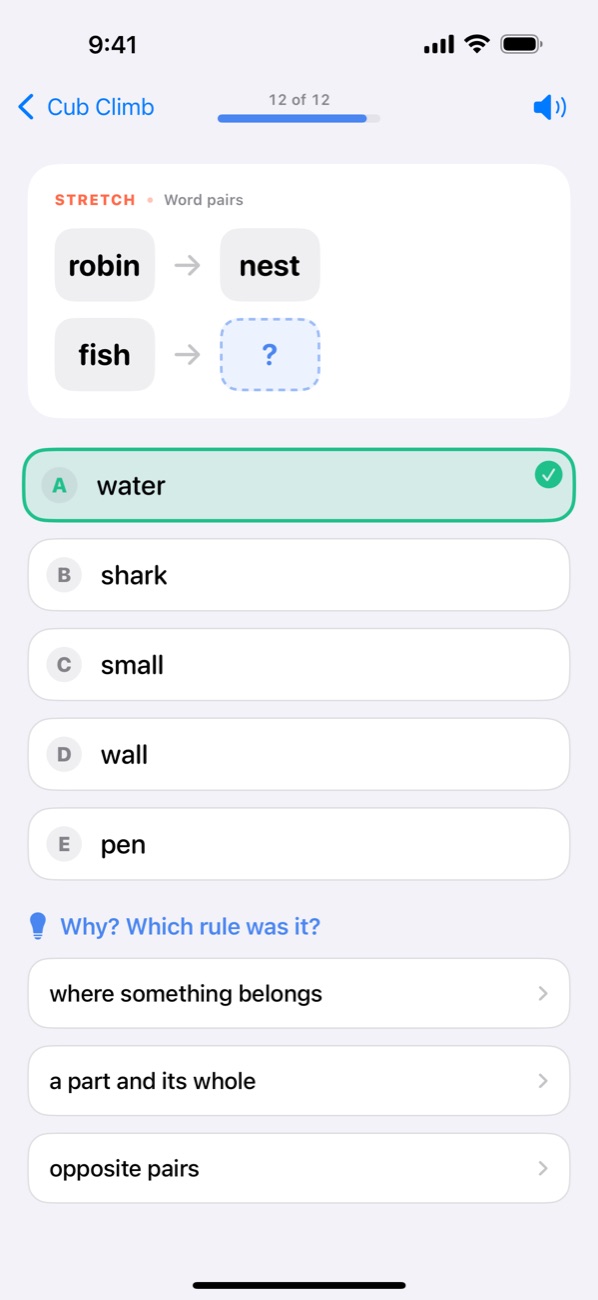
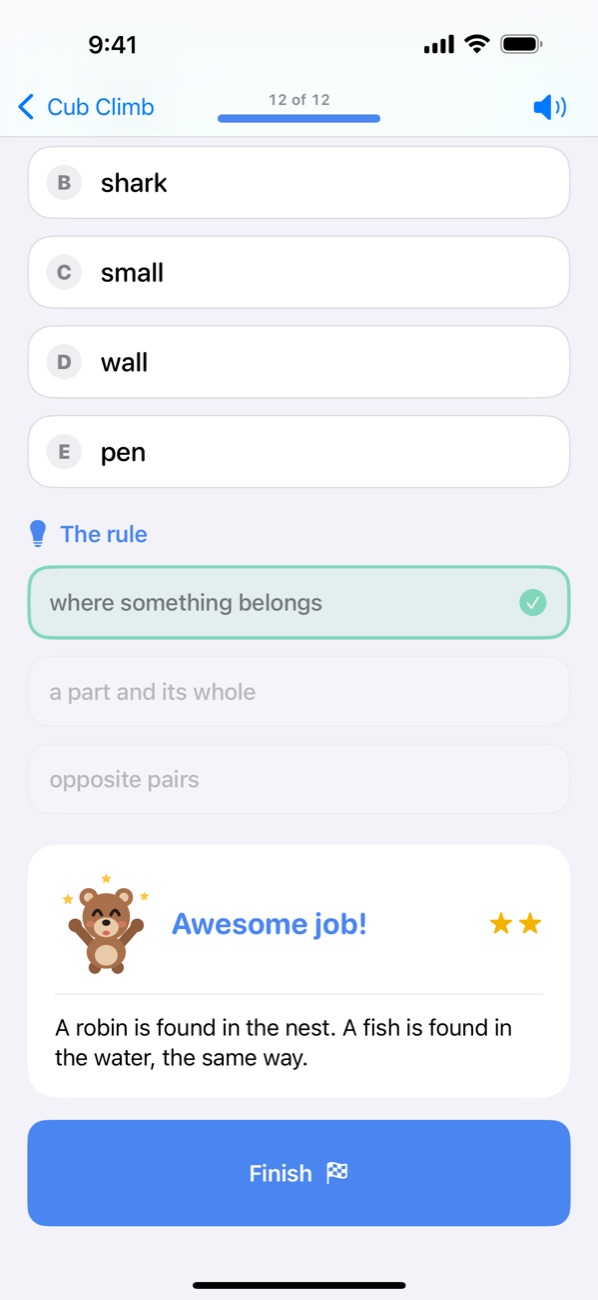
If the rule picked is wrong, the app shows which one they chose and the right one, so the explanation is never skipped. See the whole app.
Sources
- Chi, De Leeuw, Chiu & LaVancher (1994). Eliciting self-explanations improves understanding. Cognitive Science, 18(3)
- Rittle-Johnson (2006). Promoting transfer: Effects of self-explanation and direct instruction. Child Development, 77(1)
- Bisra, Liu, Nesbit, Salimi & Winne (2018). Inducing self-explanation: A meta-analysis. Educational Psychology Review, 30
- Dunlosky, Rawson, Marsh, Nathan & Willingham (2013). Improving students’ learning with effective learning techniques. Psychological Science in the Public Interest, 14(1)
- TDSB Ward 13, Universal Screening and Gifted Programming, ward forum deck, 24 November 2022 (PDF)
From the makers of this blog
Cub Climb: reasoning puzzles that ask “why?”
- All three kinds of reasoning: words, numbers and shapes, nine puzzle types, 3,600+ original puzzles for grades 3 to 8.
- Answer, then say why. One star for the answer, a second for naming the rule, then the cub explains it in plain words.
- Missed puzzles come back after 1, 3 and 7 days, and a grown-ups’ area shows which skills are going well.
The first 20 puzzles are free. Then a season pass that never renews, or monthly. See how it works.
More from the blog
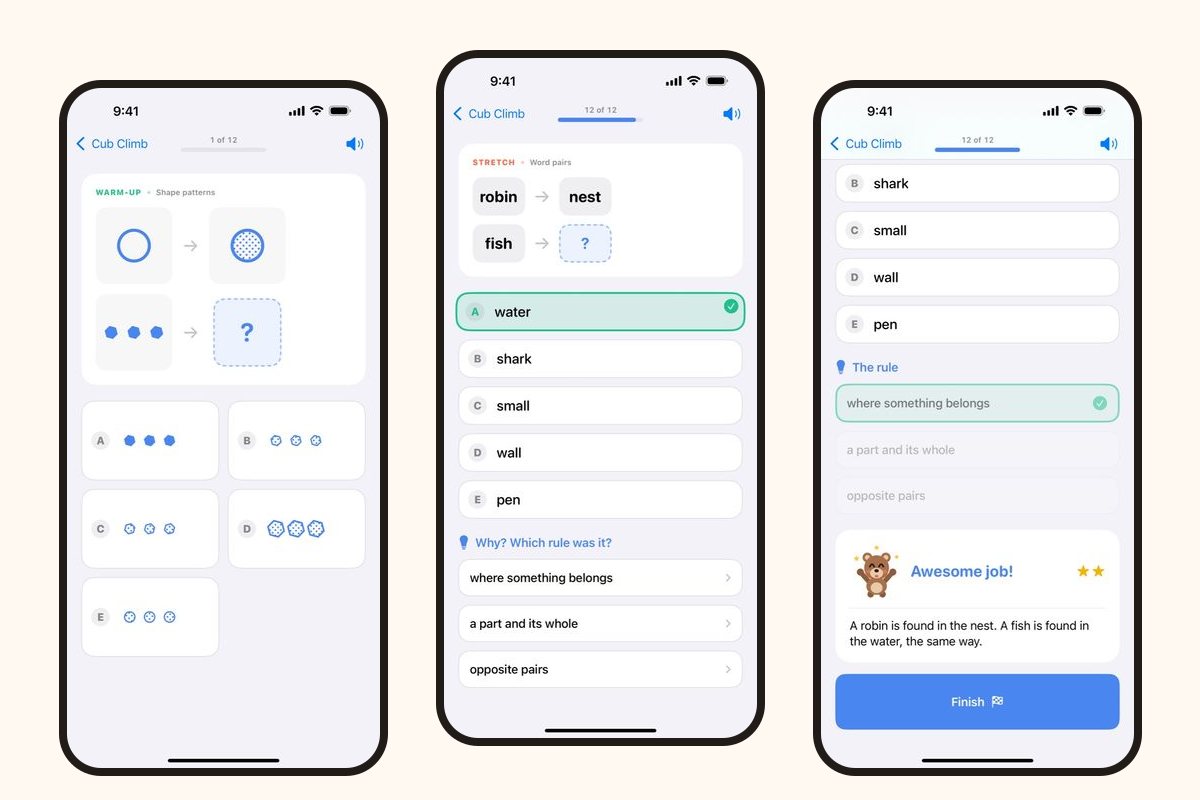 How Cub Climb builds reasoning, puzzle by puzzleA tour of the Cub Climb app on real screens: the three kinds of reasoning, answer-then-why, missed puzzles that come back, and what grown-ups see.
 York Region’s Grade 3 gifted screening, explainedWhen York Region screens Grade 3 students for gifted programs, what the CCAT looks at, and what happens after — from the board’s own published procedure.
 12 reasoning games to play at home this weekBoard games, word games and puzzles that build verbal, number and visual reasoning — including the ones a Toronto school board suggests to its own families.
Cub Climb is not affiliated with, endorsed by, or connected to any school board, test publisher or testing organisation. CCAT-7, CogAT, OLSAT and CAT4 are trademarks of their respective owners.