York Region’s Grade 3 gifted screening, explained
8 October 2026 · 5 min read

The short answer: York Region District School Board gives the Canadian Cognitive Abilities Test (CCAT) to all Grade 3 students each year in late November to early December. It is the first of two stages, and only students who meet its criterion go on to an individual assessment with the board’s psychology staff.
When does it happen, and who takes it?
The board’s screening “takes place each year in late November to early December,” and Stage One is given “to all grade three students.” That is about six weeks after Toronto’s board, which screens its Grade 3s in October. Other boards use other grades and tests; there is a board-by-board guide.
What does the CCAT look at?
Reasoning, in three areas: verbal (thinking with words), quantitative (thinking with numbers) and non-verbal (thinking with shapes and patterns). Toronto’s board describes the same test as one that “does not test the Ontario Curriculum.” York Region’s procedure calls it the CCAT without naming an edition. For the three areas and the kinds of question in each, see verbal, quantitative and non-verbal reasoning, explained.
What happens after the screening?
- 1. Group screening
- All Grade 3 students take the CCAT. Those who meet the board’s criterion are referred to Stage Two.
- 2. Individual assessment
- A member of the board’s Psychological Services gives a standardized cognitive measure, the WISC-V.
- IPRC
- Students at or above the 98th percentile on the General Ability Index are considered by the Identification, Placement and Review Committee, which also looks at school achievement and other information.
- Placement
- Options include a regular class with indirect support, or a full-time gifted program (partially integrated).
The procedure doesn’t give a timeline for Stage Two or the committee. Your school can tell you.
Should my child prepare?
York Region’s procedure doesn’t mention preparation. Toronto’s board, which uses the same kind of test, is explicit: “no advance preparation or practice is permitted.” Its policy is explained in what TDSB says about test prep. If you are unsure what applies in York Region, ask your school.
My child missed the Grade 3 screening. What now?
The board says students who didn’t take it, including students new to the board, may be screened at a later grade. There are two other routes:
- Through the school. A teacher can bring a student to an In-School Team Meeting, which decides whether to ask Psychological Services for an assessment.
- Through a private assessment. Parents of current students can give the home school an assessment by a registered psychologist or psychological associate.
Questions parents ask
When does York Region screen for gifted?
Each year in late November to early December, in Grade 3.
Does every Grade 3 student take the CCAT in York Region?
The board’s procedure says Stage One, the Canadian Cognitive Abilities Test, is given to all grade three students.
What result does a child need?
The board does not publish the Stage One cut-off. To be considered by the IPRC, a student needs a result at or above the 98th percentile on the General Ability Index of the Stage Two assessment, the WISC-V.
What if my child is new to the board?
Students who missed the Grade 3 screening, including new students, may be screened at a later grade.
Can I use a private assessment instead?
Parents of current students can give their home school a psychological assessment by a registered psychologist or psychological associate.
Sources
From the makers of this blog
Cub Climb: reasoning puzzles that ask “why?”
- All three kinds of reasoning: words, numbers and shapes, nine puzzle types, 3,600+ original puzzles for grades 3 to 8.
- Answer, then say why. One star for the answer, a second for naming the rule, then the cub explains it in plain words.
- Missed puzzles come back after 1, 3 and 7 days, and a grown-ups’ area shows which skills are going well.
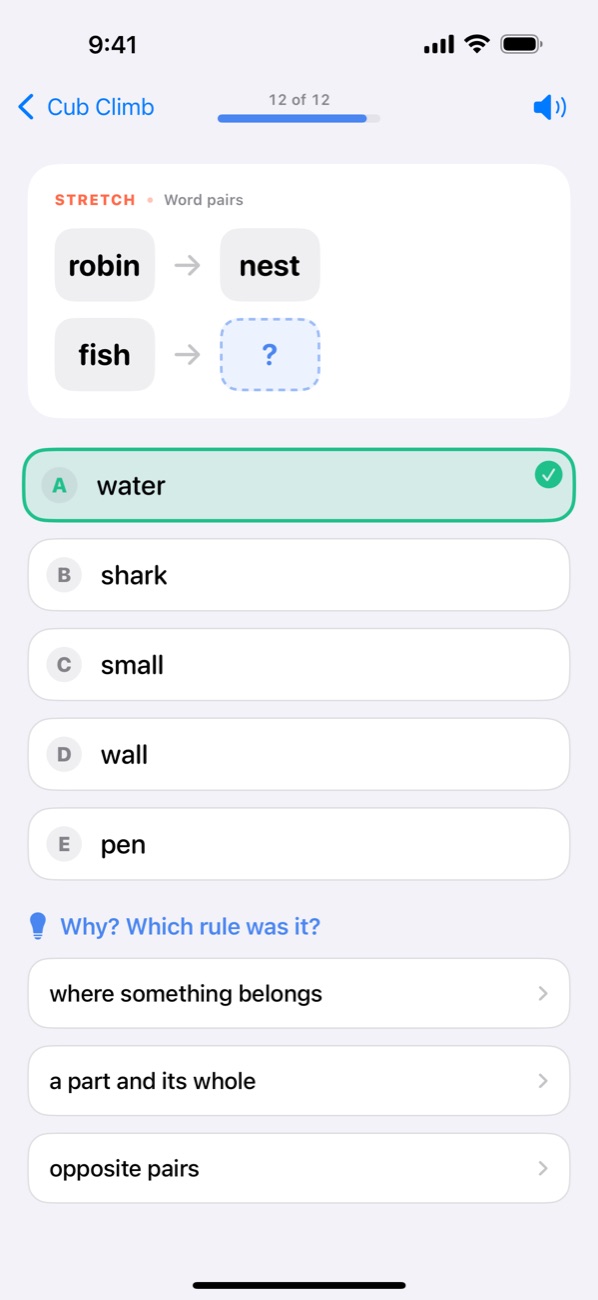
The first 20 puzzles are free. Then a season pass that never renews, or monthly. See how it works.
More from the blog
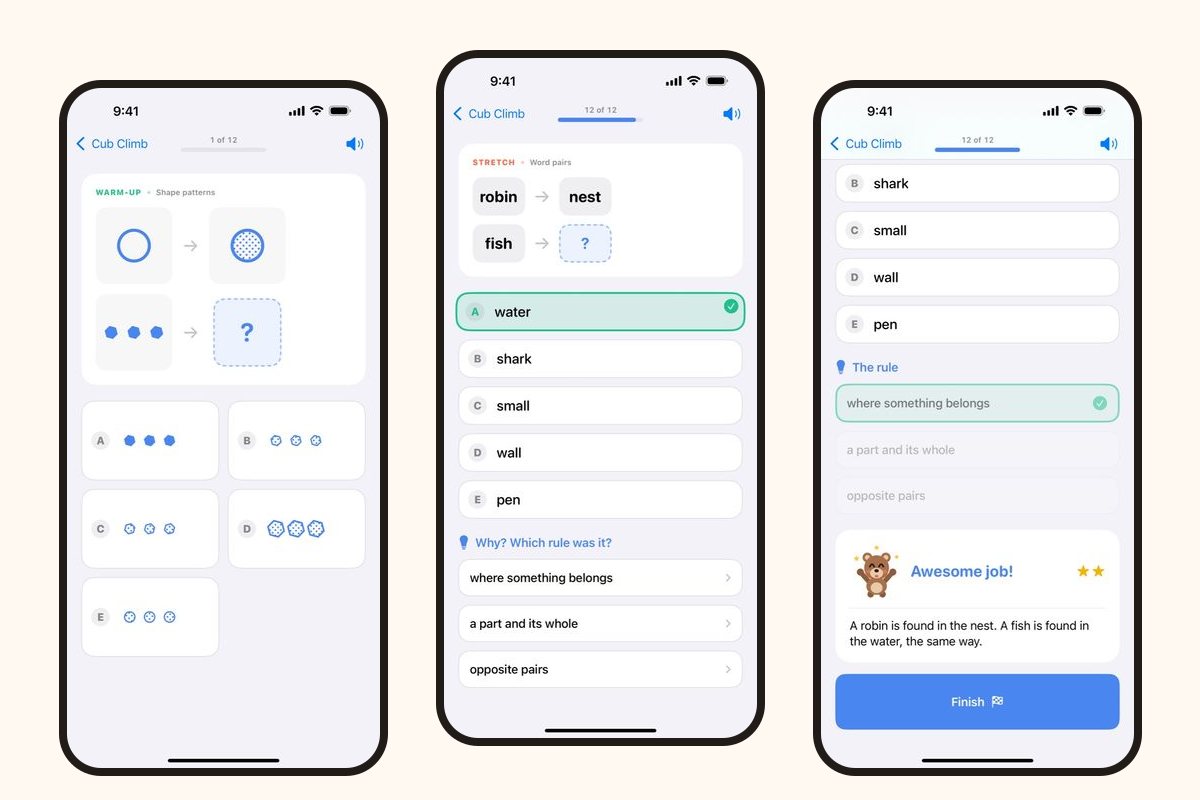 How Cub Climb builds reasoning, puzzle by puzzleA tour of the Cub Climb app on real screens: the three kinds of reasoning, answer-then-why, missed puzzles that come back, and what grown-ups see.
 12 reasoning games to play at home this weekBoard games, word games and puzzles that build verbal, number and visual reasoning — including the ones a Toronto school board suggests to its own families.
 Verbal, quantitative and non-verbal reasoning, explainedThe three kinds of reasoning gifted screenings like the CCAT-7 and CogAT look at, in plain words, with one puzzle of each to try with your child.
Cub Climb is not affiliated with, endorsed by, or connected to any school board, test publisher or testing organisation. CCAT-7, CogAT, OLSAT and CAT4 are trademarks of their respective owners.