Verbal, quantitative and non-verbal reasoning, explained
8 October 2026 · 5 min read
If your child has a gifted screening coming up, you’ve probably seen the words verbal, quantitative and non-verbal. They are the three kinds of reasoning that screenings like the CCAT-7 and the CogAT look at. Here’s what each one means in plain words, with a puzzle of each to try together.
Verbal reasoning: thinking with words
Verbal reasoning is seeing how words and ideas relate: which go together, which don’t, and why. In the CCAT-7 it covers verbal analogies, sentence completion and verbal classification. It isn’t about long words. It’s about connections between ordinary ones.
Try it: an analogy
Ant is to tunnel as bee is to ___
apple · small · shark · hive · up
Show the answer and the rule
Hive. The rule is where something belongs: an ant lives in a tunnel, a bee lives in a hive.
Try it: which word belongs?
Blue, green, orange, ___
circle · pink · paint · rainbow · shade
Show the answer and the rule
Pink. They are all colours. Paint and rainbow are about colour, but they aren’t colours themselves, which is a good thing to talk through.
Quantitative reasoning: thinking with numbers
Quantitative reasoning is finding the rule in numbers, not doing long sums. The CCAT-7 covers number analogies, number series and number puzzles. A child who can say “it goes up by three each time” is reasoning, even before the arithmetic.
Try it: what comes next?
0, 3, 6, 9, 12, ___
9 · 12 · 13 · 14 · 15
Show the answer and the rule
15. Add the same amount each time. Each number is 3 more than the one before, so 12 plus 3 is 15.
Non-verbal reasoning: thinking with shapes
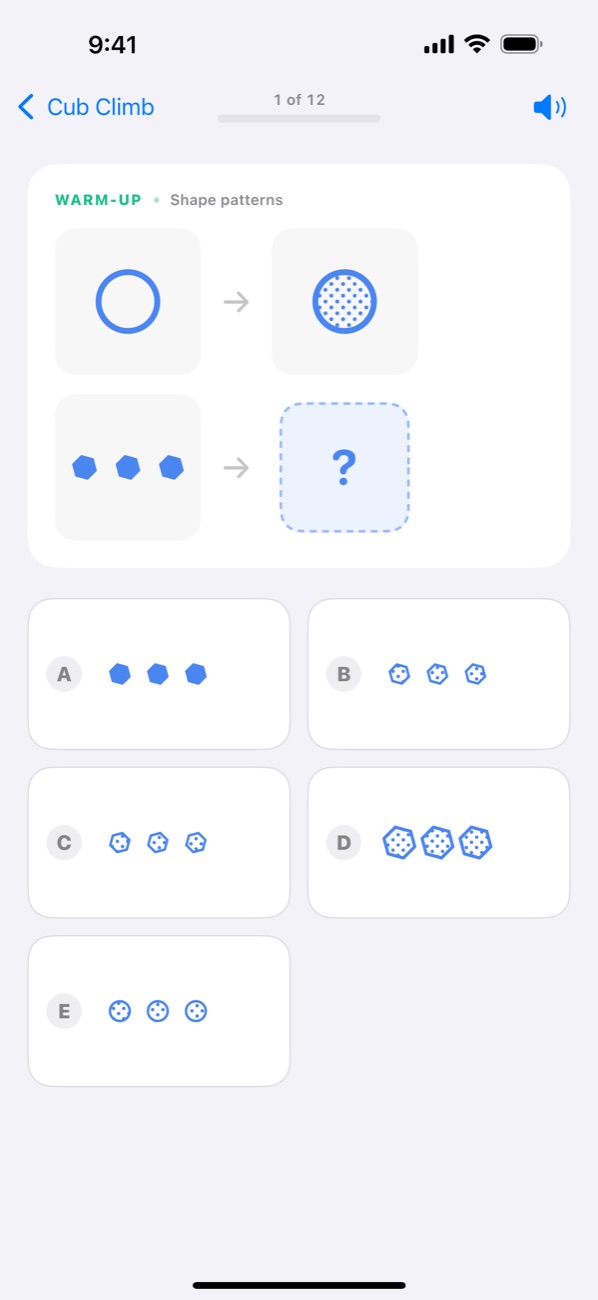
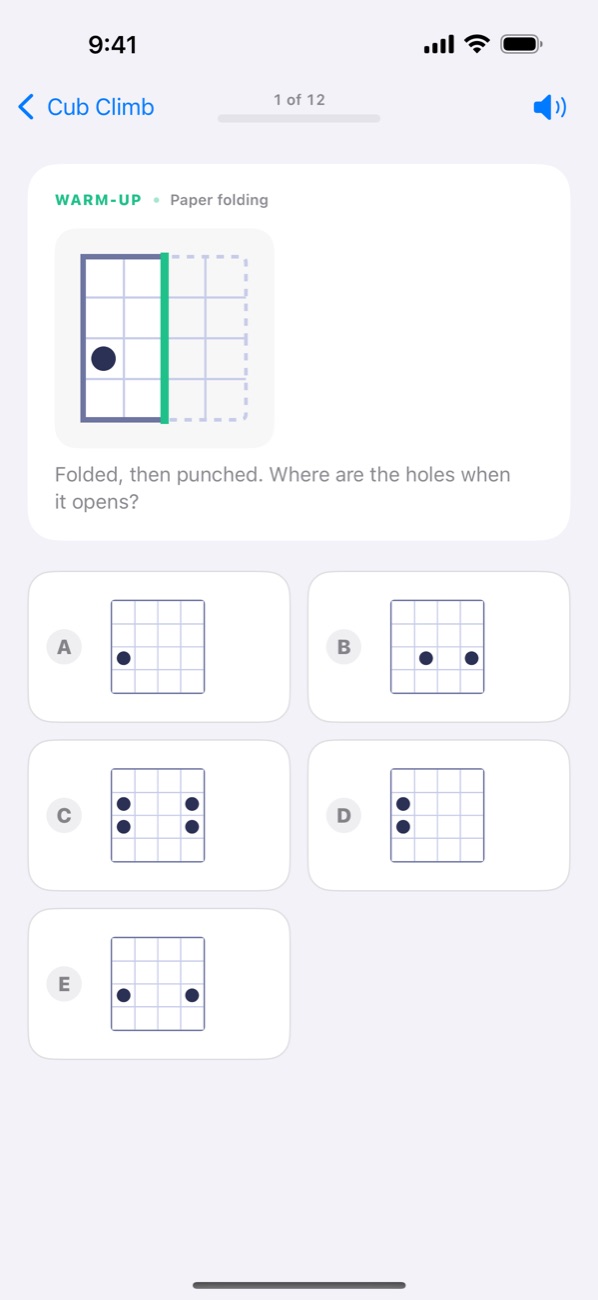
Non-verbal reasoning works without words or numbers. It covers figure matrices (how one shape changes into another), figure classification (which shape belongs with a group) and paper folding (where the holes end up when a punched sheet is unfolded).
Here are two from the Cub Climb app, drawn the way your child would see them:
For more, here are all nine kinds of puzzle, drawn, and some to play free in your browser.
Does a child need to practise these?
Toronto’s board is clear that children shouldn’t practise for its screening. TDSB’s policy explains why. What it suggests instead is everyday reasoning at home: word games, number games and puzzles. There are twelve to start with, and a full guide to the CCAT-7 covers levels, timing and scoring.
Sources
From the makers of this blog
Cub Climb: reasoning puzzles that ask “why?”
- All three kinds of reasoning: words, numbers and shapes, nine puzzle types, 3,600+ original puzzles for grades 3 to 8.
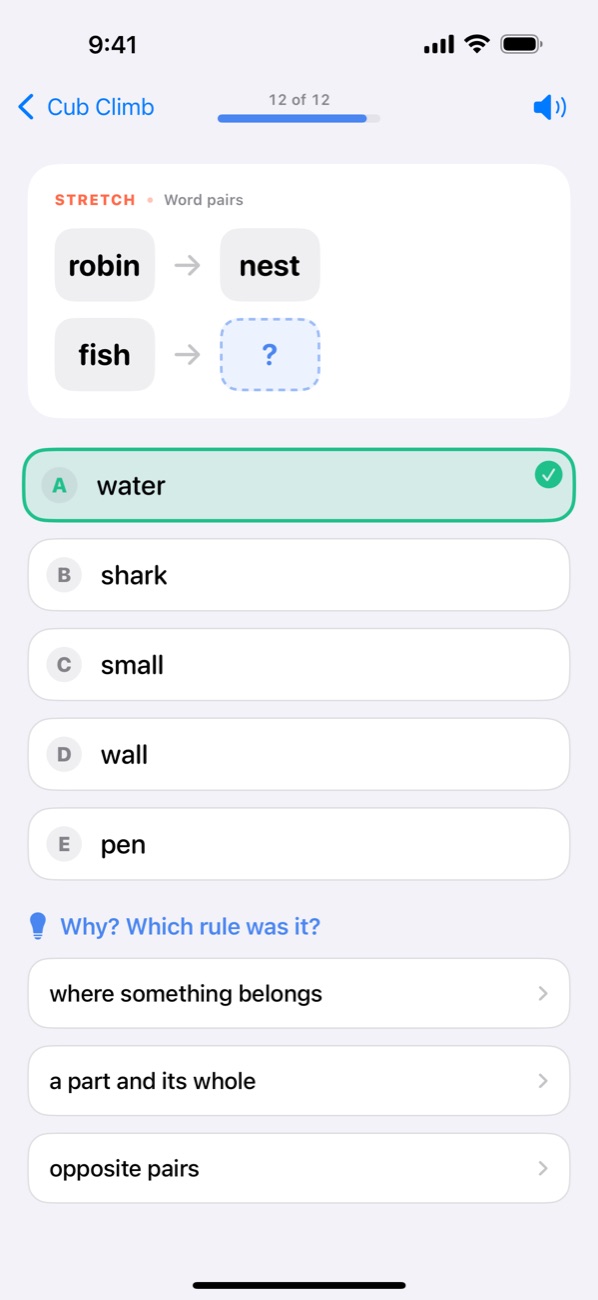
- Answer, then say why. One star for the answer, a second for naming the rule, then the cub explains it in plain words.
- Missed puzzles come back after 1, 3 and 7 days, and a grown-ups’ area shows which skills are going well.
The first 20 puzzles are free. Then a season pass that never renews, or monthly. See how it works.
More from the blog
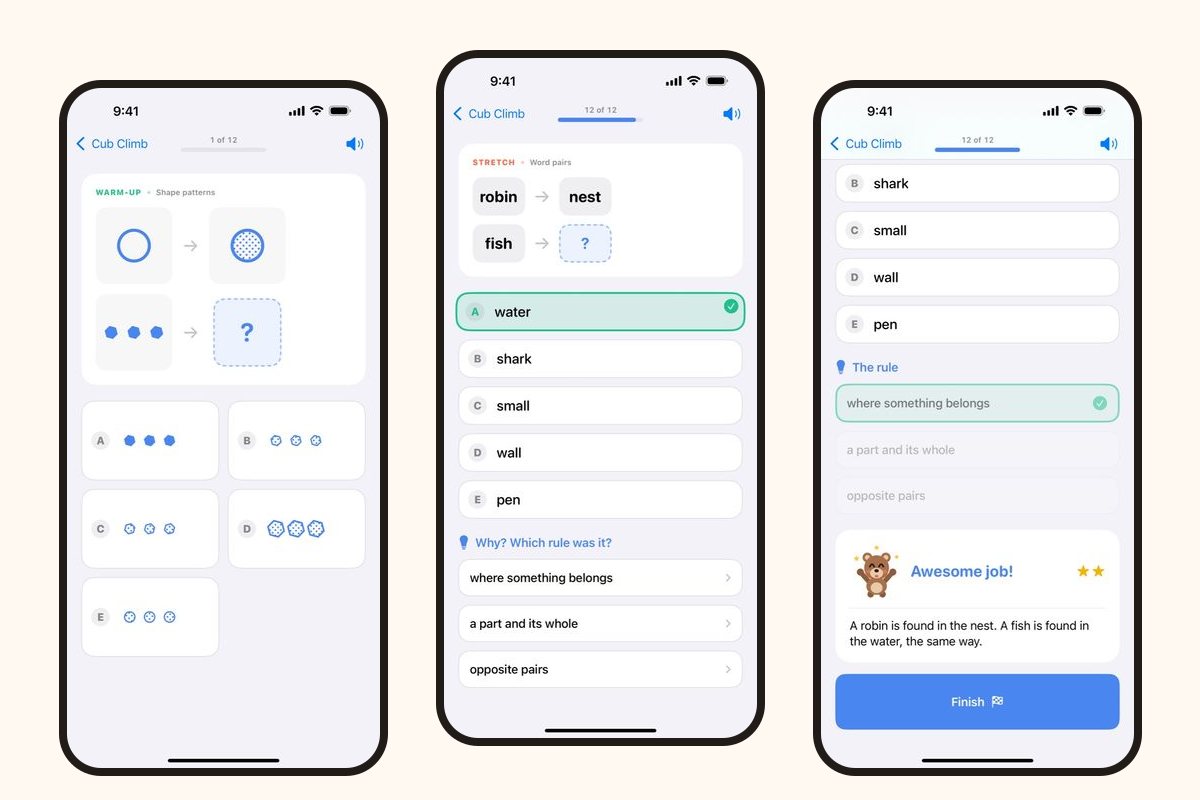 How Cub Climb builds reasoning, puzzle by puzzleA tour of the Cub Climb app on real screens: the three kinds of reasoning, answer-then-why, missed puzzles that come back, and what grown-ups see.
 York Region’s Grade 3 gifted screening, explainedWhen York Region screens Grade 3 students for gifted programs, what the CCAT looks at, and what happens after — from the board’s own published procedure.
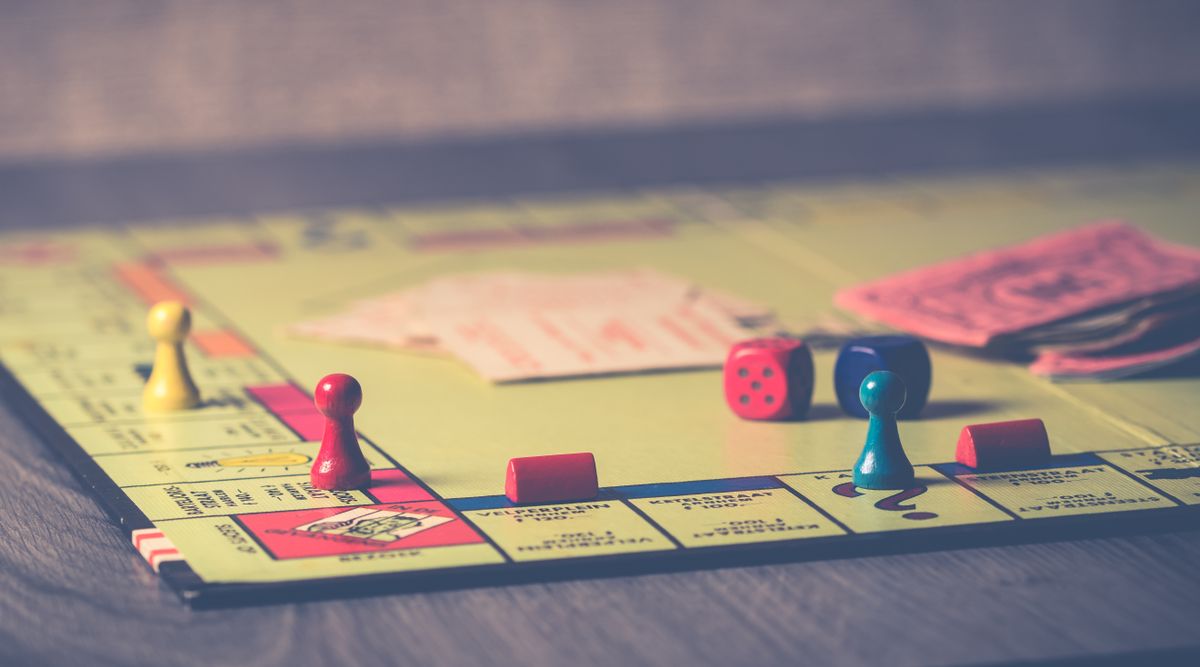 12 reasoning games to play at home this weekBoard games, word games and puzzles that build verbal, number and visual reasoning — including the ones a Toronto school board suggests to its own families.
Cub Climb is not affiliated with, endorsed by, or connected to any school board, test publisher or testing organisation. CCAT-7, CogAT, OLSAT and CAT4 are trademarks of their respective owners.