How many spelling words a week? What grades 1 to 5 learn
7 November 2026 · 5 min read
No curriculum in North America sets a weekly spelling list. The list is a school habit; the curriculum sets what children should be able to spell by the end of the year, and it is mostly patterns, not particular words. So the length and the words vary from class to class. Here is what is typical, and what each year is about.
How many words a week?
It grows with age. One widely used free set of lists, K12Reader’s, gives 8 words a week in grade 1, 16 in grades 2 and 3, and 21 in grades 4 and 5, for 36 weeks. Published programmes sit around the same range: roughly 5 to 12 in grade 1, 10 to 17 in grade 2, 12 to 20 in grade 3, and 14 to 21 in grades 4 and 5. Many classes split the list in two, a shorter one and a longer one, or add a few challenge words.
In England the lists are usually shorter, about 8 to 10 words, and often come from two statutory lists of 100 words each, for Years 3 and 4 and for Years 5 and 6.
What each grade learns
- Grade 1. Grade 1 spelling is about sounds: one letter for each sound in a short word, then two letters that make one sound (sh, ch, th), the silent e that makes a vowel say its name, and by spring the common vowel teams (rain, tree, boat) and simple endings. Common Core asks for final -e and common vowel teams in grade 1. Grade 1 lists
- Grade 2. Grade 2 spelling takes the grade 1 patterns into longer words (rabbit, explain, mountain) and adds more vowel teams, prefixes and suffixes, and the rules for adding endings. The same sound can be spelled more than one way, and a child learns which spelling usually goes where. Grade 2 lists
- Grade 3. Grade 3 spelling turns from sounds to word parts and history: silent letters left over from old English, endings like -ful and -less, and the rules for adding -ed and -ing. It is the year Ontario’s curriculum adds spelling by meaning. Grade 3 lists
- Grade 4. Grade 4 spelling is about endings that sound alike and are spelled differently (-tion, -sion, -ture), and about borrowed spellings like ph. Knowing a word’s ending usually tells a child what kind of word it is, too. Grade 4 lists
- Grade 5. Grade 5 spelling is about long words: endings that sound the same (-ance, -ence), doubled letters nobody hears, and Latin roots that carry the meaning (port means carry, rupt means break). A child who knows the root can often spell a word they have never seen. Grade 5 lists
What the curricula actually say
Common Core asks grade 1 to “use conventional spelling for words with common spelling patterns and for frequently occurring irregular words”, and grade 2 to generalize learned patterns to new words (its own example: cage to badge, boy to boil). Ontario’s 2023 Language curriculum puts spelling with phonics and morphology, and from grade 3 adds spelling by meaning, using word parts.
The practical upshot for a parent: a list built around one pattern is a lesson, not ten separate words. If this week is -tion, ten words practised well teach a hundred.
No list from school?
Some classes stop sending lists in the upper grades, or send one every few weeks. Our free lists for grades 1 to 5 follow the order above, ten words each, and every one can be shared with a class and practised out loud in Spell Cub. For how to practise a list, see how to help with the weekly spelling test.
Sources
- Common Core State Standards, Language, Grade 1 (L.1.2)
- Common Core State Standards, Language, Grade 2 (L.2.2)
- Ontario Ministry of Education. The Ontario Curriculum, Language (2023): the program in language
- K12Reader. Spelling worksheets and weekly lists, grades 1 to 5
- Department for Education (England). English Appendix 1: Spelling (2013)
From the makers of this blog
Spell Cub — this week’s spelling list, out loud, free for the whole class
- One link for the class. One parent or teacher pastes the list; everyone else taps the link and practises, with no sign-up and nothing to install.
- Hear it, spell it, fix it. The word in a sentence, spelled from memory, and a miss fixed straight away.
- Planned around test day, a little each day, with a rehearsal before the test. Grades 1 to 5.
Free for every child, with no ads and nothing to buy. See how it works.
More from the blog
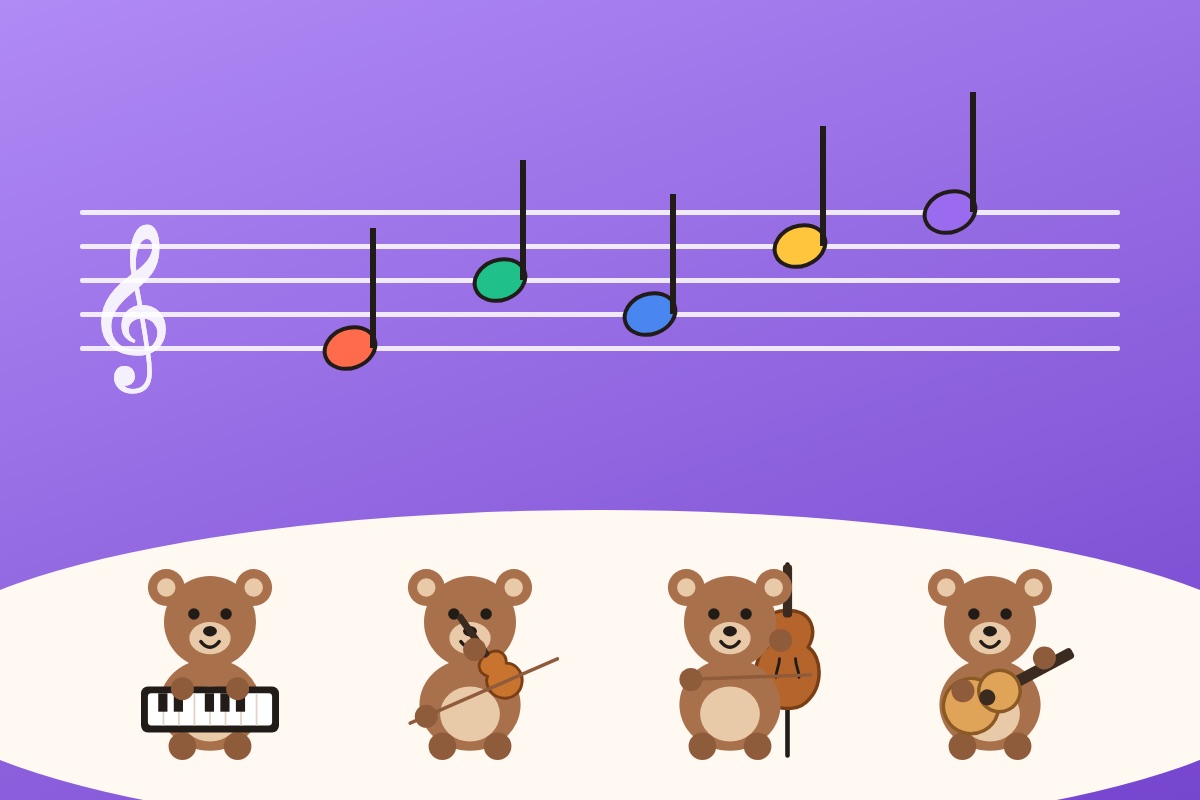 Music exams around the world: ABRSM, Trinity, RCM and AMEBThe first music exams in the UK, Canada, the US and Australia, what they ask a beginner to read, and a quarter-note-to-crotchet glossary.
- Reading music
- United Kingdom
- United States
- Canada
- Australia
 Meet Spell Cub: one link for the whole class’s spelling listCub Climb’s third app is free for every child: one parent pastes the weekly spelling list, everyone practises it out loud by test day. Why we built it.
- Spelling
 How to help with the weekly spelling test: what the research saysWriting words from memory beats copying, checking each word at once beats checking at the end, and four short days beat one long night. With sources.
- Spelling
- How children learn
Cub Climb is not affiliated with, endorsed by, or connected to any school board, test publisher or testing organisation. CogAT, NNAT, OLSAT, CCAT-7, CAT4 and other test names are trademarks of their respective owners.